
Koh Ker and Beng Mealea – Ultimate guide
If you are planning a trip to Cambodia beyond Angkor Wat, make sure Koh Ker is on your list. Once the capital of the Khmer Empire, Koh Ker is home to the impressive Prasat Thom, jungle-covered temples like Prasat Pram, and many hidden ruins that feel completely different from Angkor. Combined with the atmospheric Beng Mealea and the intricate carvings of Banteay Srei, this makes one of the most unforgettable day trips from Siem Reap.
This article is not just a quick travel tip but a complete guide to Koh Ker, including its history and mysteries, the most important temples, our own personal experience from visiting with a guided tour, as well as practical details like how to get there, when to go and what to expect. At the end you will also find a FAQ section to help you plan your visit more easily.
We visited Koh Ker at the very end of our three-month Asia journey, and it turned out to be the cherry on top of our Cambodian adventure. Let us show you why this underrated site deserves a spot on your itinerary.
History of Koh Ker
Koh Ker was once the capital of the Khmer Empire for a short period in the 10th century, during the reign of King Jayavarman IV (921–944 CE). Unlike Angkor, which became the long-term center of the empire, Koh Ker rose briefly as a royal city before the court returned to Angkor in the mid-10th century.
At its peak, Koh Ker covered an area of around 80 km², with more than 180 temples scattered across the forest. It was dedicated primarily to the cult of Shiva, with enormous lingas placed in its sanctuaries as symbols of divine power.
The city also featured an advanced hydraulic system, with barays (water reservoirs) and canals designed to provide water in an otherwise dry region. Water played both a practical role in sustaining the city and a symbolic role in Hindu cosmology, representing the ocean that surrounds Mount Meru.
After the capital shifted back to Angkor, Koh Ker gradually declined. By the 15th century, the city was largely abandoned. Today, it is best known for its unique pyramid temple, Prasat Thom, and the hauntingly beautiful jungle-covered sanctuaries like Prasat Pram.On September 17, 2023, Koh Ker was officially inscribed as a UNESCO World Heritage Site, a recognition that ensures greater preservation and international attention.
Unsolved Mysteries & Theories
Despite what archaeologists know, much about Koh Ker remains a mystery.
Why was Koh Ker abandoned?
Some theories suggest that severe droughts made it difficult to sustain the city, while others believe it was weakened by conflict with neighboring Siam (Thailand). Another possibility is that the shift of political power back to Angkor left Koh Ker neglected.
Damage before abandonment
Local accounts say that parts of the city were damaged even before it was deserted. Khmer treasure hunters reportedly searched the temples, sometimes even using elephants to move stones in search of hidden wealth.
The lost linga
Prasat Thom once contained a massive linga, one of the largest ever erected in Cambodia. Today, only the shaft where it once stood remains — the linga itself has mysteriously disappeared.
Hidden treasures beneath the stones
Archaeologists believe much of Koh Ker is still unexplored. Since no manuscripts or books were found here, only wall carvings and fragments of inscriptions remain, leaving questions about what lies beneath the collapsed structures.
Modern legacy
Cambodia still has an estimated 3–6 million landmines, a tragic legacy of more recent wars. Ironically, Koh Ker gained unexpected attention among younger generations when fans of Lara Croft: Tomb Raider began visiting similar jungle temples, bringing new interest in Cambodia’s hidden ruins.
Highlights of the Koh Ker Tour
Beng Mealea
Our first stop was Beng Mealea, a temple often compared to Ta Prohm because of the way giant spung trees grow over its walls and courtyards. Built in the 12th century, Beng Mealea was dedicated to Vishnu and is sometimes called the “female temple,” as it was built by a Khmer king for his guru.
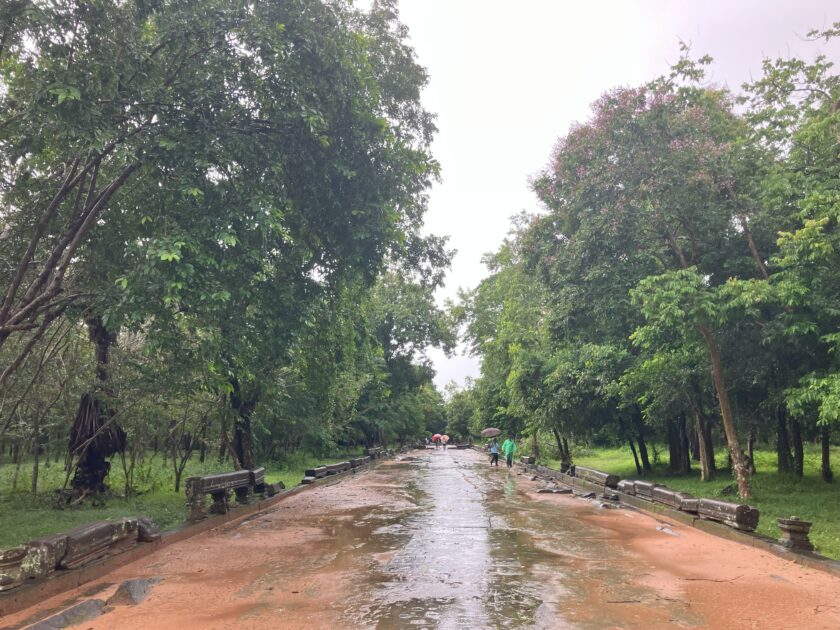
Walking through the ruins felt like stepping into a forgotten world. The temple is heavily damaged, with collapsed galleries and broken stones scattered across the site, but this only adds to its mystical atmosphere. Some areas are unsafe to enter, so visitors walk along wooden pathways.
We saw the naga carvings near the doors — naga, the many-headed serpent, is believed to be a protector and also symbolizes the rainbow, connecting our world with the spirit world. The birdman figure carved into the walls is another mysterious detail that fascinated us.

Unlike Angkor Wat, no books or written manuscripts were found here. Only wall carvings and drawings remain, so much about the temple’s original purpose is still unknown. Our guide explained that we don’t even know exactly what lies beneath many of the fallen stones, since proper excavations have been limited due to lack of resources.
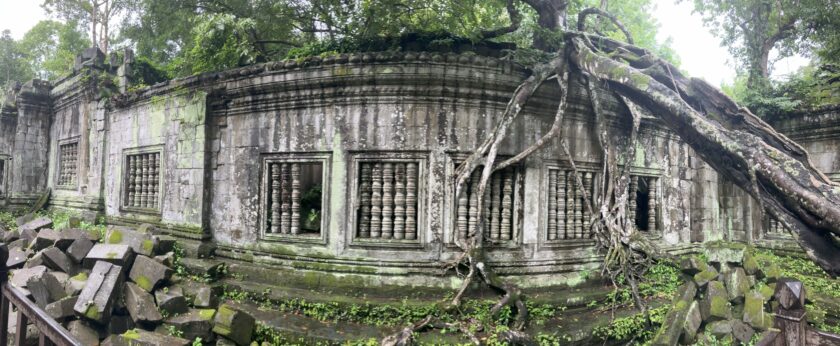
The temple is surrounded by spung trees whose roots now hold parts of the structure together. These hollow trees were never good for construction, but here they’ve become part of the ruins. It reminded us of how, when Angkor was rediscovered, temples were also completely swallowed by the jungle, with trees and even wild animals inside.

Another detail is the original naga statue, which was believed to act as a protector of the temple. In Khmer mythology, naga is connected with water and the rainbow, and symbolizes the path between worlds.
Even though much of Beng Mealea is ruined, it remains deeply atmospheric. It’s one of the few temples where you can really imagine what Angkor looked like when explorers first stumbled upon it in the jungle.
Koh Ker Group
After Beng Mealea, we continued deeper into the jungle to reach the Koh Ker group of temples. Koh Ker was once a royal city and even served as the capital of the Khmer Empire for a brief time in the 10th century under King Jayavarman IV. It is not just one temple but a whole city spread across the forest, with dozens of sanctuaries, shrines, and hidden ruins.
Prasat Pram
Our first stop was Prasat Pram, which means “five towers.” Built in the 10th century, this sanctuary consists of five brick towers, some of them dramatically embraced by tree roots. It is dedicated to Shiva, and inside stood lingas as offerings to the god.
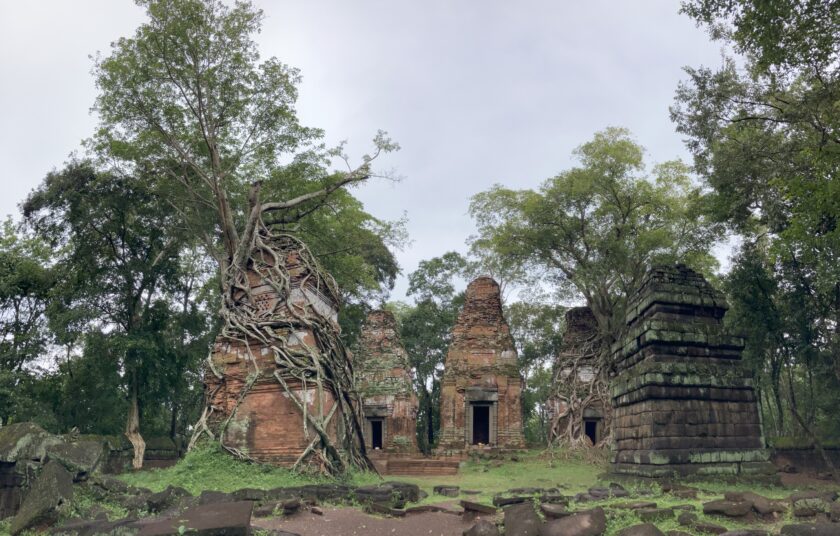
The atmosphere here is haunting — trees now hold the ruins together, and it shows clearly how the jungle has both destroyed and preserved these monuments. When Angkor temples were rediscovered, they were in a similar state: swallowed by roots, sometimes even inhabited by animals, because no one had lived there for centuries.
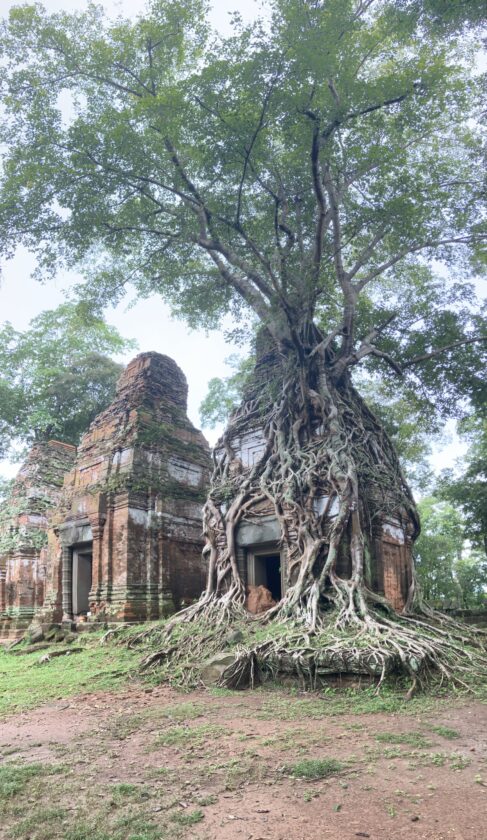
Our guide explained the meaning of the linga and yoni found inside: symbols of male and female energy, representing balance and creation.
Another interesting feature is the fake doors carved into the towers. Many Khmer temples have them — perhaps as a spiritual passage for spirits, or simply as a structural element to support the temple walls.
Prasat Linga
Koh Ker is often called the “city of lingas,” and nowhere is this clearer than at Prasat Linga. Here, dozens of stone lingas were placed as sacred offerings, symbolizing Shiva’s creative power. These lingas are connected with yoni bases, showing the eternal unity of masculine and feminine forces.
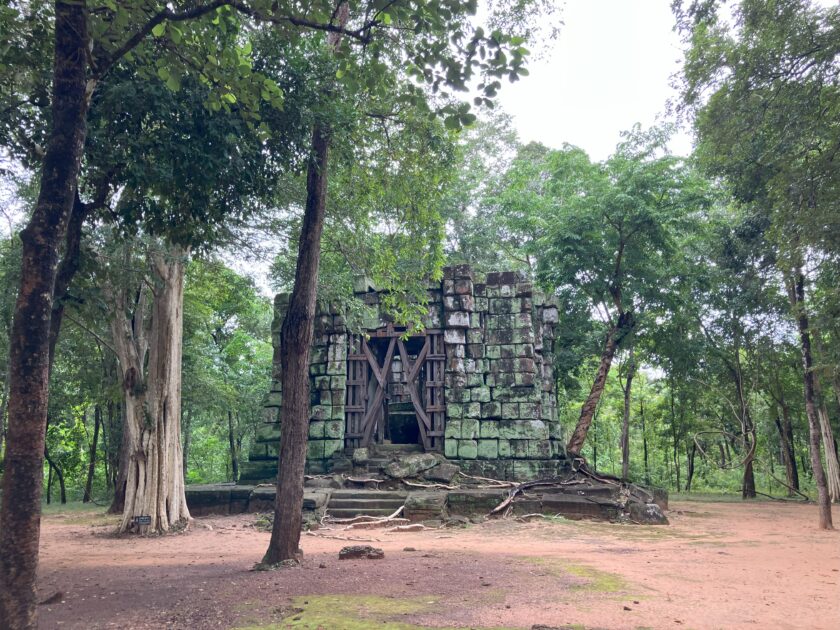
Standing among the lingas gave the site a unique atmosphere, different from the grand temples of Angkor — more intimate, symbolic, and mysterious.
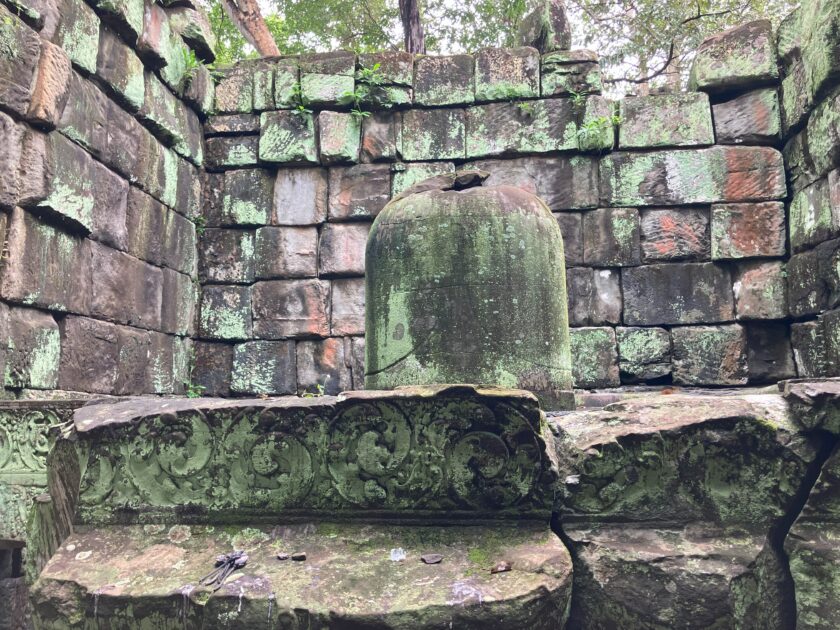
Prasat Neang Khmau
Another temple we visited in the Koh Ker complex was Prasat Neang Khmau, which translates as the Temple of the Black Lady. Built from red bricks and dedicated to Shiva, the sanctuary has darkened over time, giving it its distinctive “black” appearance.
Although smaller and less impressive than Prasat Thom, it has a mysterious atmosphere. Local legends speak of a “black lady” connected to the temple, which adds to its mystique. The temple stands quietly along the road, surrounded by trees, and makes a nice stop on the way to the pyramid.
Prasat Thom
The highlight of Koh Ker is undoubtedly Prasat Thom, the largest and most iconic temple of the site. Sometimes people mistakenly call it “Koh Ker,” but it is actually one temple within the complex.
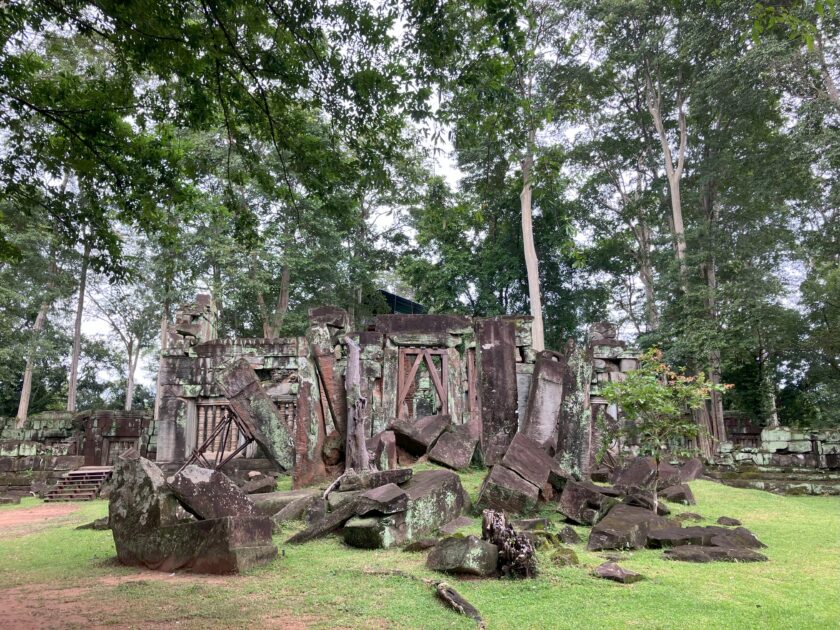
Prasat Thom is a seven-tiered pyramid, rising about 35–36 meters high, making it one of the most unique monuments in Cambodia. Inside, there was once a massive linga placed in a shaft, but it has disappeared over time. The hole where it stood is still visible.
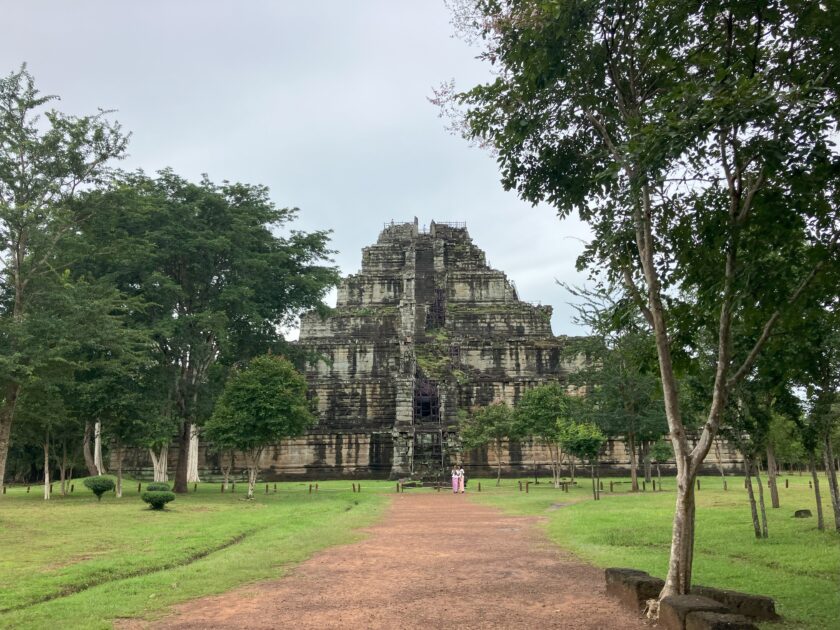
The pyramid was built from lava stones, a material both durable and symbolic. The window frames were designed to be removable — practical engineering that still surprises archaeologists today.
Water played an essential role in the symbolism of the temple. It represented the cosmic ocean surrounding Mount Meru, the center of the Hindu universe, and also served to protect the temple physically.
Our guide told us that many of the statues originally found here have been taken to museums in Phnom Penh and beyond. One particularly famous statue, though only 70% intact, was discovered here.
Today, Prasat Thom feels raw and authentic. There is no electricity at the site, only a few solar panels. This makes sunset views from the top even more magical. Unlike Angkor, which can be crowded, here you can often sit quietly and watch the jungle turn golden.
On September 17, 2023, Koh Ker was officially recognized as a UNESCO World Heritage Site. This recognition has made the site more significant and will hopefully ensure better preservation for the future.
Banteay Srei
The final stop of the day was Banteay Srei, also known as the “Lady Temple.” Unlike Koh Ker’s massive structures, Banteay Srei is famous for its delicate carvings made from pink and yellow sandstone. The fine quality of the stone has preserved details that would have eroded elsewhere, which is why Banteay Srei is considered one of the most beautiful temples of Angkor.
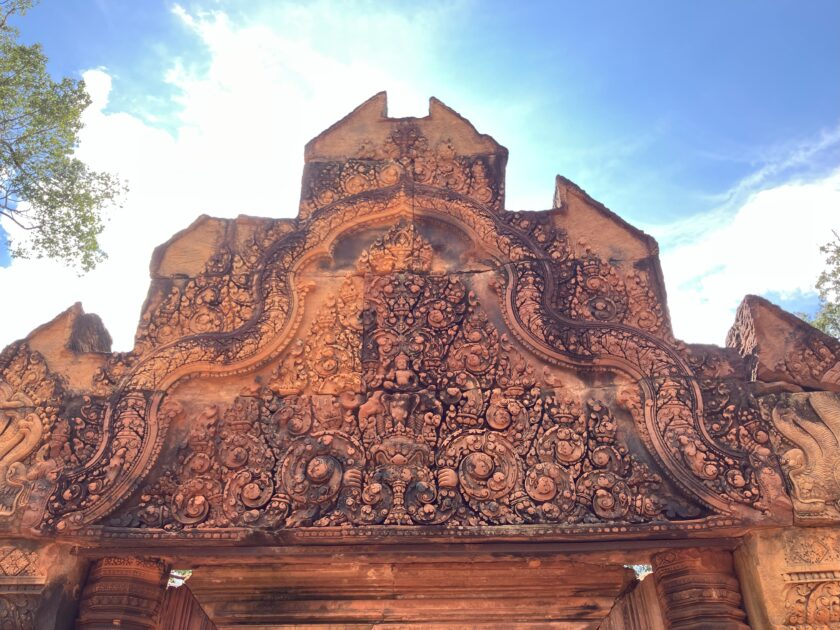
The carvings tell Hindu stories — depictions of Shiva with his wife Parvati, Indra riding his elephant, and the demon Kala. The temple is sometimes called the “Eastern Mona Lisa” because of the elegant female figures carved in the stone.
Our guide explained that Banteay Srei was built in the 10th century, possibly as a temple for women or perhaps named so because of the rosy color of the stone. Its location near the mountains suggests the stone was quarried nearby. Some parts are closed off now for preservation, as the structure is fragile.
Our Day on the Koh Ker Tour
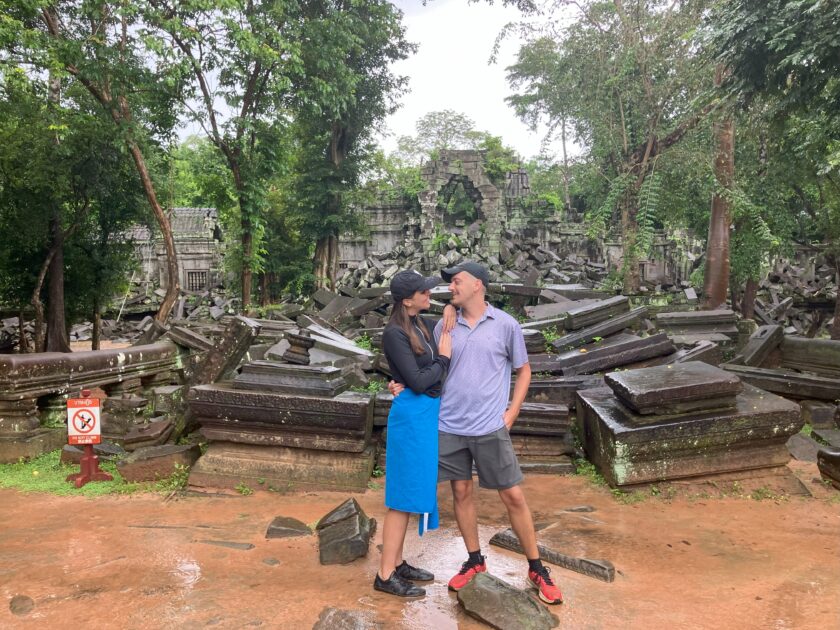
The Koh Ker excursion was our last trip in beloved Cambodia, and it felt like the perfect ending to our week around Angkor. The day before, we had spent a full day exploring the temples of the Angkor Wat complex again, this time with a guide (more about that in our upcoming article). It had been the hottest day of our trip, and by the evening Filip was close to heatstroke. So the next morning, when our guide picked us up around 7:30 am for the Koh Ker tour ([tour link]), and it was raining, we were honestly relieved and excited. For once, we wished for rain — and it came true.
Our first stop was Beng Mealea, about an hour and fifteen minutes away from our stay at Villa Sun. This temple can be visited either with a separate $10 entrance fee or included in the 7-day Angkor Pass, which we had. (We’ll share more about those 7 days in Angkor in another article.) Beng Mealea, though heavily ruined, felt mysterious and impressive. Its sheer size and the way it has been overtaken by the jungle makes it an absolute must-see. Despite suffering some of the heaviest damage of all the temples, it is still a phenomenal sight that left us in awe.
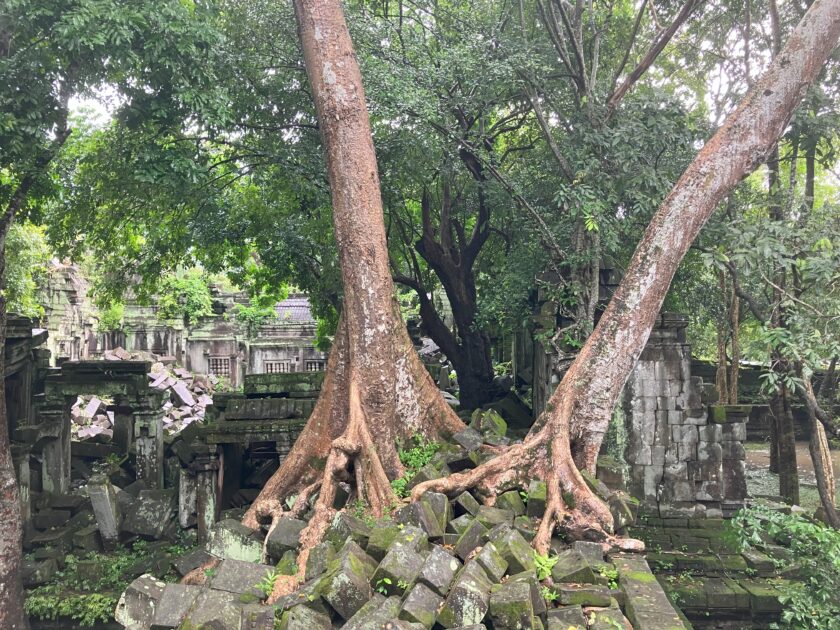
Next, we drove to Prasat Pram. Although small, this temple surprised us with its haunting beauty. We loved the way the trees grow into the brick towers, roots and branches merging with the architecture. It was still lightly raining at times, but after the exhausting heat of the previous day, we didn’t mind at all — in fact, it felt refreshing.
We then stopped at Prasat Linga (at least that’s what we remember it being called 😅). It was another small temple, but just as fascinating. All of the temples were nicely spread out along the route, so the journey felt smooth and enjoyable. Our guide also took some amazing photos of us here, which we really appreciated!
We also stopped briefly at Prasat Neang Khmau, known as the Temple of the Black Lady. It was a small red-brick temple, darker in color than the others, which gave it a unique look. While not as striking as the main pyramid, it had its own mysterious charm, and we enjoyed the quiet atmosphere before continuing to Prasat Thom.
After that came the highlight of the trip: Prasat Thom, the most famous temple of Koh Ker. Some people say it looks a bit like Chichen Itza in Mexico, and we could definitely see the resemblance. But Prasat Thom is more than just a pyramid. The complex has a front section, part of which is currently under restoration to keep it from crumbling. As we walked further, we reached the main seven-tiered pyramid itself — a truly spectacular sight.

In front of the pyramid, you can stop for photos before climbing the staircase built alongside the structure. From the top, the view over the jungle is breathtaking. We stayed up there for a while, soaking in the scenery, and it was easily the highlight of the whole tour.
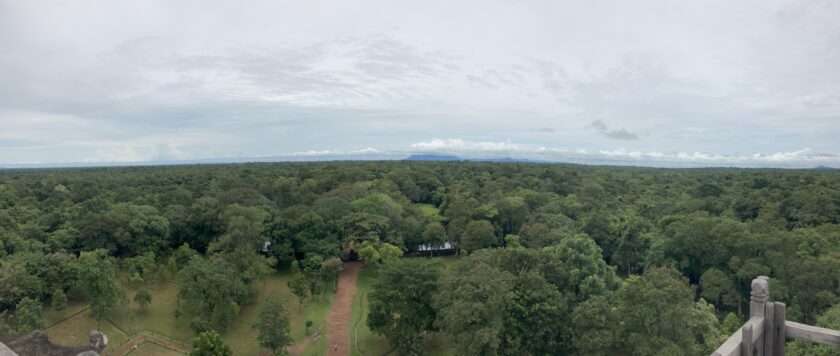
Once we had enjoyed the view enough, we climbed down, got back to the car, and were handed fresh bottles of water and even cold towels soaked in lemon — such a thoughtful detail that felt amazing after walking in the humidity.
Our final stop of the day was Banteay Srei. This temple was a little further away, but the drive was worth it. What struck us most were the incredibly well-preserved details, thanks to the unusually hard sandstone used for its construction. Our guide pointed out the famous carving of a woman nicknamed the “Mona Lisa of the East.” He joked that whoever named her must never have actually seen the real Mona Lisa, because she looked nothing alike. Still, the delicacy of the carvings here was unmatched and unforgettable.
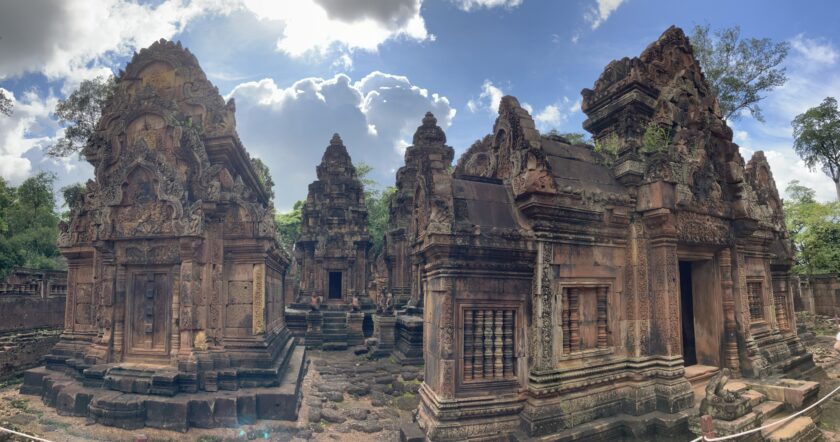
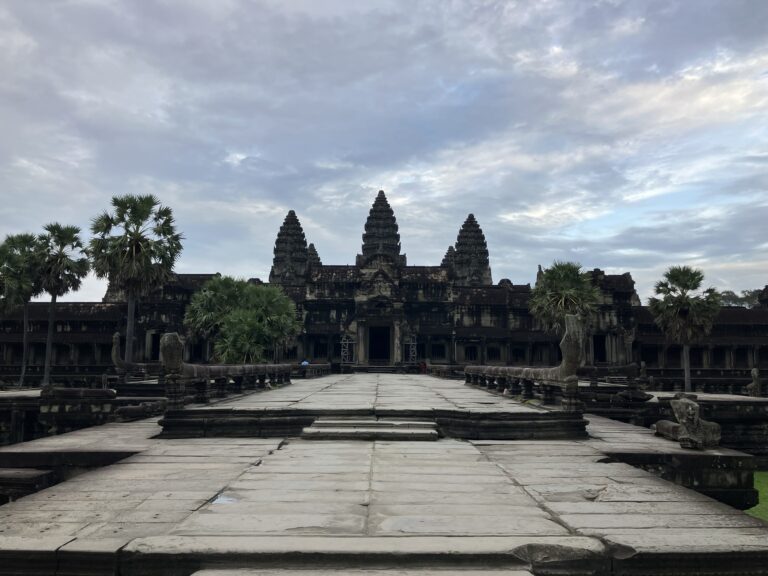
After Banteay Srei, we were supposed to head straight back, but we made one last special request: to stop by Angkor Wat one final time. Since it was our last evening in Cambodia, we wanted to say goodbye. We spent the evening walking around the temple, quietly taking it all in, and feeling grateful for the week we had spent there. It was the perfect way to close our Cambodian journey.
Our Koh Ker Tour with ASEAN Angkor Guide
We explored Koh Ker as part of a day trip with ASEAN Angkor Guide, a tour company that has some of the best ratings on Tripadvisor and GetYourGuide for its professionalism and friendly service.
The tour cost $69 per person and included a knowledgeable local guide, hotel pick-up, unlimited drinking water, a tasty lunch, and even refreshing cold towels soaked in lemon. One detail we really appreciated was the comfortable transfer — the minivan had reclining seats and plenty of legroom, which made the longer journey to Koh Ker much more enjoyable.
Keep in mind that entrance tickets are purchased separately. Koh Ker requires a $15 ticket, while Beng Mealea is included in the Angkor Pass (or $10 on its own). Since we already had the 7-day Angkor Pass, it worked perfectly — and it even allowed us to stop by Angkor Wat again in the evening after the tour, which felt like the perfect way to say goodbye.
If you’d like to book the same trip, you can easily do it through GetYourGuide here.
Best Time to Visit Koh Ker
The best time to visit Koh Ker depends on what you are looking for.
High Season (November – March): This is the most popular time to visit Cambodia, when the weather is cooler, drier, and generally more comfortable for sightseeing. The downside is that temples, including Angkor and even Koh Ker, can be much busier, and at popular sunrise or sunset spots it’s not unusual to wait 20 minutes or more for a photo.
Low Season (May – October): This is the rainy season, which many travelers try to avoid. Afternoon showers are common, and the humidity can be intense. On the other hand, the countryside is at its greenest, the temples look even more atmospheric surrounded by lush vegetation, and there are far fewer tourists.
We visited Cambodia at the end of August and beginning of September during our three-month journey across Asia. This is considered the rainy season, and many guides don’t recommend it — but for us, it turned out to be a great decision. It hardly rained during the day, usually only in the evenings, and the one exception was during our Koh Ker tour, when we actually wished for rain after the previous day’s scorching heat. And it came true — much to Filip’s relief, since he had almost suffered a heatstroke the day before 😅.
Traveling in low season meant that at many temples, even in Siem Reap and the Angkor complex, we were almost completely alone. It made the experience much more romantic and peaceful, as we could truly enjoy the atmosphere without crowds. The temperatures were still hot — around 30°C — and when the sun came out it could feel intense, but since we are used to tougher travel conditions, it wasn’t a problem for us. In fact, we would probably choose to visit off-season again for the quieter and more authentic atmosphere.
How to Get There
Koh Ker lies about 120 km northeast of Siem Reap, and the journey takes around 2 to 2.5 hours each way. Since the temples are spread across the jungle, it’s not the easiest place to reach on your own.
If you don’t have a rental car or motorbike, the most convenient and often even the cheapest option is to join a guided tour. Taxis or private drivers from Siem Reap tend to be expensive, and they usually only cover the transfer — no guide, no water, no lunch. A tour, on the other hand, includes pick-up from your hotel, a knowledgeable guide, unlimited drinking water, lunch, and comfortable transport with reclining seats and plenty of legroom. On a long day with multiple stops, this really makes a difference.
That’s why we joined the ASEAN Angkor Guide tour, and it turned out to be the perfect choice. The organization was smooth, our guide shared plenty of insights, and all the small details (like cold lemon towels) made the experience special.
Entrance fees:
- Koh Ker requires a separate ticket ($15).
- Beng Mealea costs $10, but if you have the Angkor Pass it’s included.
- Banteay Srei is also covered by the Angkor Pass.
The Angkor Pass costs $37 for one day, $62 for three days, or $72 for seven days. We had the 7-day pass, which was perfect — after finishing the tour, we even used it to stop at Angkor Wat one last time before leaving Cambodia.
Where to Stay for Visiting Koh Ker
Since Koh Ker is visited almost always as a day trip, the best option is to stay in Siem Reap. The city has accommodation for every budget — from budget hostels to boutique hotels and luxury resorts.
During our trip, we stayed at Villa Sun – Boutique Hotel, a small and very welcoming place in Siem Reap, and absolutely loved it. The staff went above and beyond for us, and it was the perfect base for exploring Angkor and taking this tour to Koh Ker. (Full review coming soon!)
For more options, check our interactive map below with recommended stays in Siem Reap.
Practical Tips for Visiting Koh Ker
Buy your Angkor Pass online in advance – If you plan to combine Koh Ker with Beng Mealea or Banteay Srei, it’s best to buy your Angkor Pass on the official Angkor Enterprise website. This way you avoid resellers and overpaying. Prices are $37 for 1 day, $62 for 3 days, or $72 for 7 days.
Don’t skip Koh Ker even if Angkor feels endless – We spent almost 7 full days exploring Angkor and still missed 2 temples out of the dozens scattered across the complex. It truly feels endless. Still, Koh Ker is a completely different experience. As a former capital city, dominated by the pyramid of Prasat Thom, it offers something unique that Angkor doesn’t. Visiting with a guide also adds a new layer of understanding, since you’ll learn details you wouldn’t notice on your own.
Dress appropriately for temples – Women must cover shoulders and knees, and men should avoid shorts. Unlike in Sri Lanka, there are no sarongs for rent or purchase inside the temple complexes, so bring a scarf, sarong, or long trousers with you.
Prepare for the heat – Temperatures often reach 30°C and above. Bring sunscreen, a hat, insect repellent, and drink lots of water. Tours usually provide unlimited bottled water, but it’s good to carry your own as well.
Good shoes are essential – The ground around Koh Ker and Beng Mealea can be uneven, with rocks, mud, or slippery roots. Wear sturdy shoes or sandals with straps rather than flip-flops.
Bring cash with you – Both US dollars and Cambodian riel are accepted. Carry small bills, as it’s often hard to get change and it is not possible to pay by card there.
Facilities – Although Koh Ker is remote, you’ll be surprised to find that the toilets are well-maintained, so no worries about rough conditions here.
Best to go with a tour – It’s possible to hire a driver, but tours really make sense here: not only for the comfort of reclining seats and legroom on the long journey, but also for the guidance and all the small extras (like cold lemon towels after the temples).
FAQ – Koh Ker & Tour Questions
Is Koh Ker worth visiting?
Yes — even though Angkor is vast and has many temples, Koh Ker offers a very different, quieter, more raw experience. Dominated by the pyramid of Prasat Thom, with fewer crowds and deeper jungle vibes, it’s a highlight for those who want to go off the beaten path.
How far is Koh Ker from Siem Reap?
About 2 to 2.5 hours each way (≈ 120 km) via mostly paved roads. Tours depart early and return by evening.
Do I need a guide?
You don’t strictly need one, but a guide makes a big difference. They share stories, point out hidden symbols, navigate paths, and make your visit more meaningful. Plus, on long days, they handle logistics so you can focus on the experience.
What is the entrance fee for Koh Ker and Beng Mealea?
Koh Ker requires a ticket of $15 USD per person. Beng Mealea either requires a separate fee (≈ $10) or is covered if you have an Angkor Pass.
Can the Angkor Pass be used for Koh Ker?
No — Koh Ker entrance is separate (requires the above $15 ticket). But if you already have the Angkor Pass for your visit to the Angkor complex, that helps — especially for Banteay Srei, and for your evening stop at Angkor Wat after the tour.
What should I wear and carry?
Dress respectfully: shoulders and knees must be covered. Bring a sarong or long pants. Carry sunscreen, insect repellent, water, hat, and comfortable shoes. Also carry small bills (USD) for entrance, tips, or snacks.
How much time do I need for Koh Ker?
A full-day tour (≈ 8–10 hours) allows time to visit Beng Mealea, several temples in the Koh Ker group (Prasat Pram, Prasat Linga, Prasat Thom, plus Neang Khmau), and Banteay Srei. If you go independently, be prepared for a long day.
Are facilities (toilets, etc.) okay at Koh Ker?
Yes — despite being remote, the site has modern and well-maintained toilets. It’s more comfortable than many expect for such a location.
Final Thoughts is Koh Ker Worth Visit?
Visiting Koh Ker was one of the highlights of our time in Cambodia and the perfect way to close our journey. While Angkor is breathtaking and truly endless, Koh Ker felt like a hidden treasure — underrated, peaceful, and almost empty, especially during the low season. At Beng Mealea we even welcomed the rain after the heat of previous days, which made the atmosphere even more mysterious.
What struck us most was how often we were completely alone among the temples, something that rarely happens in Angkor. It gave the whole day a romantic and almost timeless feeling.
For us, Koh Ker was the cherry on top of an unforgettable Cambodian adventure. If you have time beyond Angkor, don’t hesitate — we truly recommend making the trip. Whether it’s the jungle-covered ruins, the pyramid of Prasat Thom, or the calm atmosphere, Koh Ker is a place that will stay with you long after you leave.
Fitting Koh Ker into a bigger temple plan? See our 3-day Angkor itinerary and the one-day Angkor route.
Frequently asked questions
How much does Koh Ker cost to visit?
Koh Ker requires its own US$15 ticket, separate from the Angkor pass. Nearby Beng Mealea costs US$10 on its own but is included if you hold an Angkor pass.
Is Koh Ker worth the trip from Siem Reap?
If you like temples without crowds, absolutely. It is roughly a two-hour drive each way, and the seven-tiered pyramid of Prasat Thom feels like a different civilisation from Angkor – because it briefly was one.
Can you climb the Koh Ker pyramid?
Yes – a wooden staircase runs up the side of Prasat Thom to a viewing platform over the jungle canopy. It is steep but safe, and the view is the reason to come.
Planning the whole trip? Our Cambodia travel guide pulls together every article we’ve written – temples, cities, the south, plus visas and costs.